Big Time LED TV
A television you operate, not a page you scroll.
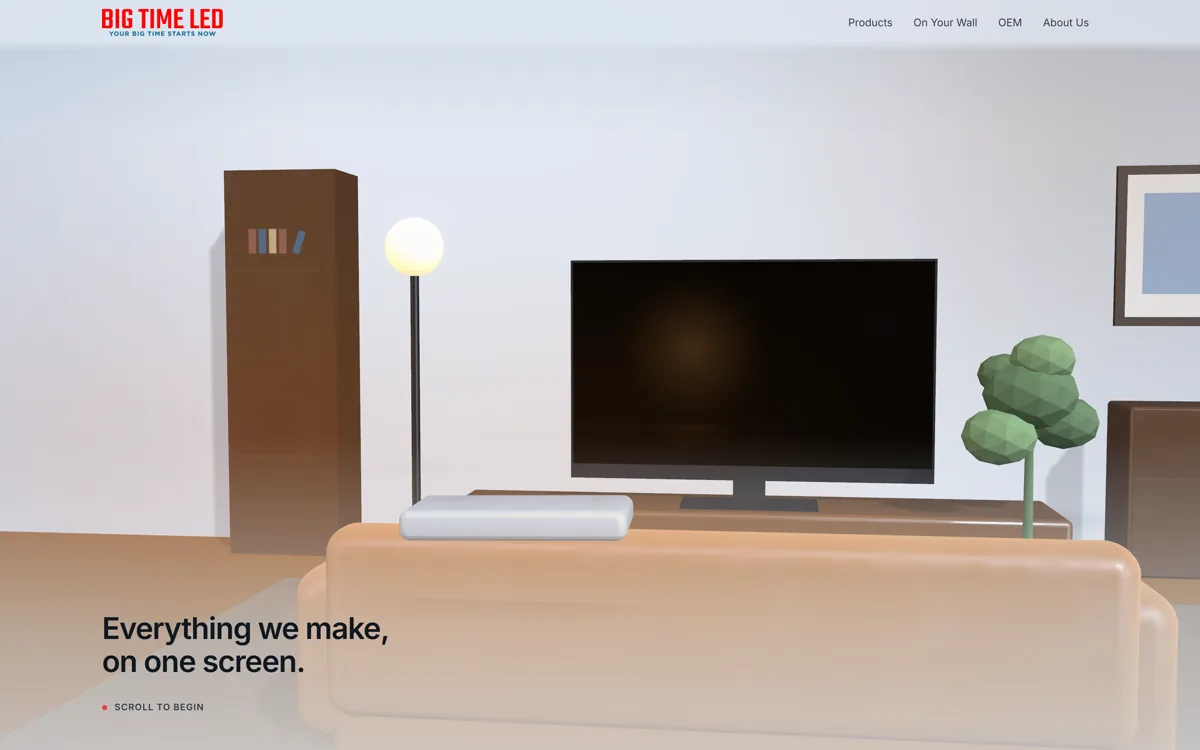
The brand site for an LED television maker in Ahmedabad, built around a scroll-driven 3D set the visitor actually operates, with a thirty-page product catalogue and an admin the client edits the copy from.
A television brand whose buying decision happens in a showroom, and whose site has to be convincing enough to get someone to drive there.
The brief was not a storefront. The client wanted a television the visitor can interact with rather than a grid of product cards, and the conversion action is a WhatsApp enquiry or a showroom visit, not a checkout. A site like that is usually built as a heavy client-rendered experience, which is exactly the wrong answer here: the links get shared into WhatsApp and Instagram, and neither runs JavaScript to build a link preview.
Server render everything, and quarantine the weight. Next.js App Router on React 19 gives every shared link a real preview, while the 3D work sits behind a boundary ESLint enforces: three.js may only be imported inside one directory, reachable through one entry file. Breaking that rule does not raise an error, it silently adds a few hundred kilobytes to the initial bundle that nobody notices until launch. The scene is scoped to the two routes that earn it, and the design tokens and motion system live in shared workspace packages so the storefront and the admin cannot drift apart.
A live brand site with a scroll-choreographed product experience, a catalogue of around thirty television pages, and a Supabase-backed admin the client signs into to edit the site copy themselves rather than sending us a message. Listing and detail only by design: there is no cart, because the sale finishes in the showroom or in a WhatsApp conversation.
Kyron Infotech designed and built Big Time LED TV for its owners, and it is published here with their agreement. The brand, the content and the business are theirs; what is ours to show is the engineering, and the reasoning behind it.